
✏️ Author: Dr. Daniel Pehböck | 📅 February 2026 | ⏱️ approx. 9 min read
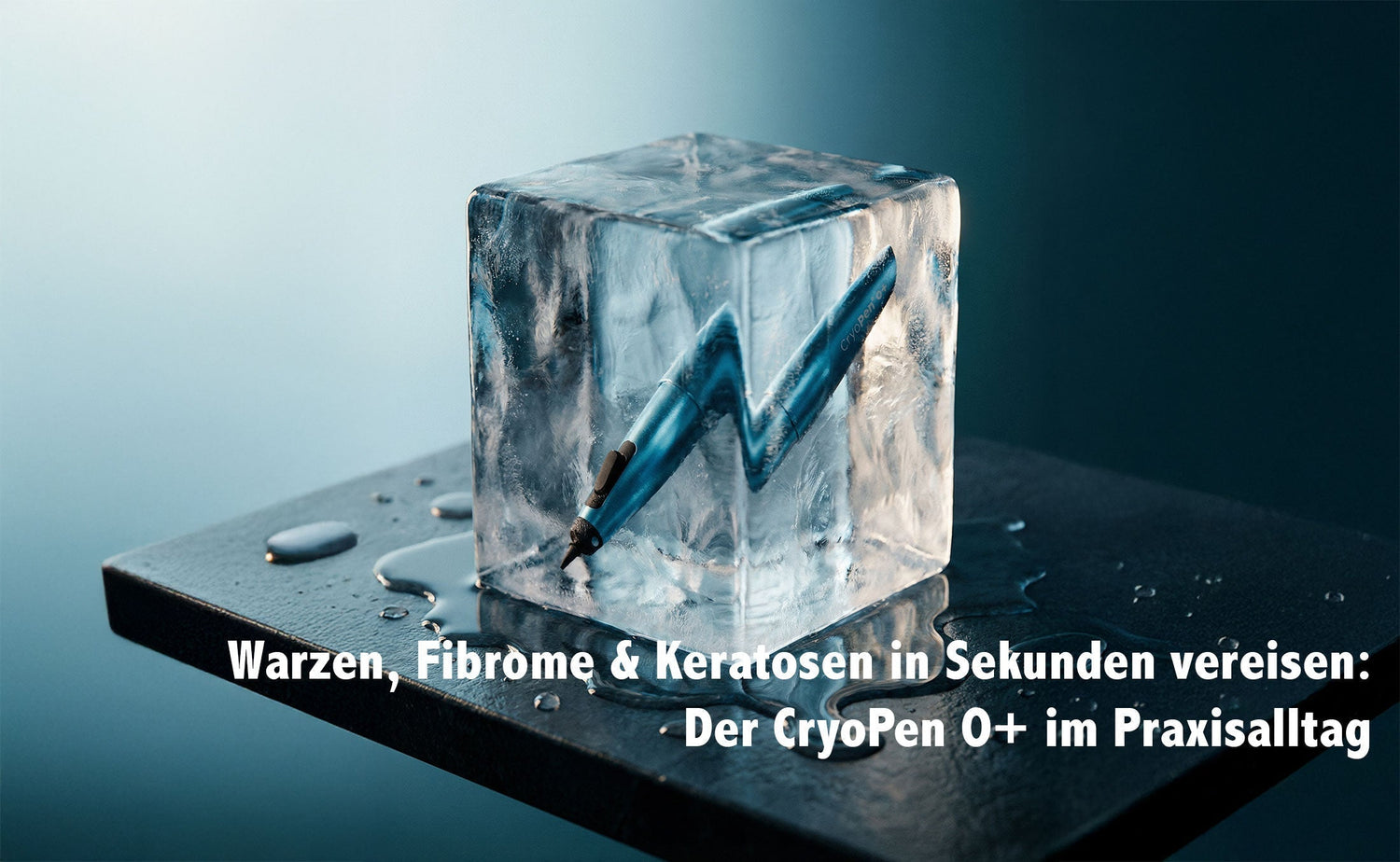
Warts, fibromas, actinic keratoses – benign skin changes are among the most common consultation reasons in general medicine and dermatology. Cryotherapy with the CryoPen O+ offers a fast, precise, and almost painless treatment method that acts in seconds and does not damage surrounding tissue. In this article, you will learn everything about the functionality, indications, and practical application of the CryoPen O+ starter set in your practice.
📋 Content
⚡ CryoPen O+ at a Glance
Method: Cryotherapy with N₂O (Nitrous Oxide)
Operating Temperature: up to –89 °C
Cartridges: 8 g or 16 g N₂O cartridges
Treatment Time/Lesion: approx. 2–30 sec.
Total Duration (8 g): 120 seconds
Total Duration (16 g): 240 seconds
Manufacturer: H&O Equipments NV, Belgium
Medical Device: Class IIa, CE certified
What is Cryotherapy? The Principle of Targeted Freezing
Cryotherapy – from the Greek "kryo" for cold – is an established dermatological procedure in which skin changes are destroyed by targeted cold exposure. The mechanism of action is based on the controlled formation of intra- and extracellular ice crystals, which lead to local tissue necrosis. The dead tissue is then expelled by the body and replaced with healthy tissue.
The CryoPen O+ uses nitrous oxide (N₂O) as a refrigerant, reaching temperatures of up to –89 °C. Compared to liquid nitrogen (N₂, –196 °C), N₂O offers significant practical advantages: it can be safely stored in compact cartridges, requires no complex cooling chain, and allows for particularly fine, controlled application.
There are basically two procedures in cryosurgery:
| Procedure | Description | CryoPen O+ |
|---|---|---|
| Liquid Freezing (Spray) | N₂O is sprayed on the lesion as a fine jet without skin contact | ✅ Standard |
| Contact Freezing | Cooled applicator is placed directly on the lesion | Possible with accessories |
The CryoPen O+ primarily works in the spray method: a fine high-pressure jet is guided contact-free over the skin change at a distance of 0.5 to 3 mm. This is not only more hygienic than contact methods but also allows for greater penetration depth and more targeted
0 Comments