
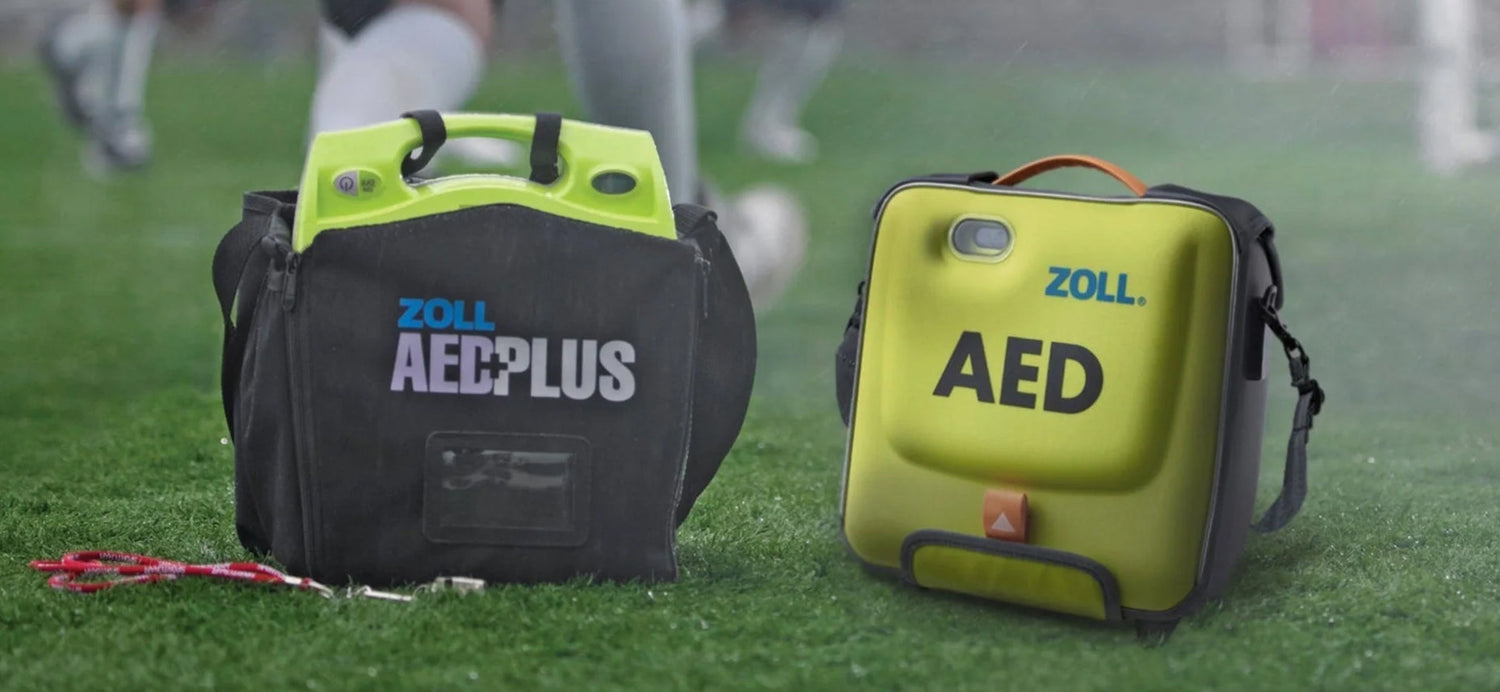
ZOLL AED 3 vs. ZOLL AED Plus – detailed comparison & purchasing advice
Those looking to acquire a defibrillator will quickly come across the two proven models from ZOLL: the AED Plus and the AED 3. Both devices are in use worldwide and reliably support first responders as well as trained users in resuscitation efforts. However, there are important differences in functionality, operation, and technical specifications that should be considered when making a purchasing decision. Below you will find a detailed comparison with practical explanations.
The ZOLL AED Plus – robust and long-proven
The AED Plus has been on the market for many years and is considered an extremely reliable device. The Real CPR Help® feature, which provides acoustic and visual feedback during chest compressions, is particularly valued. This allows the rescuer to receive real-time feedback on whether the compression depth and frequency meet the guidelines. The electrodes are designed as a single-piece CPR-D-padz® and have a durability of about five years. With its protection class IP55, the device is protected against dust and water jets, making it suitable for outdoor use. The AED Plus is available in both semi-automatic and fully automatic versions.
The ZOLL AED 3 – modern high-tech generation
The AED 3 represents the next generation and comes with several modern features. At its center is a large color display, which not only provides clear instructions but also features a so-called CPR Dashboard. Here, compression depth, frequency, and CPR quality are displayed clearly. A special feature is the RapidShock™ technology, which significantly shortens the analysis time and thus minimizes the interruption of chest compressions. This saves valuable seconds in an emergency.
The electrodes use a universal solution: the CPR Uni-padz®. These can be used for both adults and children by activating a pediatric mode. This greatly simplifies logistics, as no separate pediatric electrode set needs to be stocked. Additionally, the AED 3 optionally offers Wi-Fi connectivity, allowing maintenance status and readiness to be monitored remotely – an advantage especially for operators with multiple locations. The device also excels in terms of robustness: in addition to the IP55 protection class, the BLS variant has successfully passed a 1-meter drop test.
Differences in practical application
Both defibrillators guide users through resuscitation with clear voice and visual instructions. While the AED Plus scores mainly with simplicity and robustness, the AED 3 offers significantly more visual feedback and clearer user guidance through the display. This can be particularly helpful in stressful situations when multiple rescuers are involved.
Maintenance is also user-friendly for both devices: batteries and electrodes need to be replaced only about every five years. However, the AED 3 stands out with the possibility of automated status reports via Wi-Fi – allowing the operator to immediately recognize whether a device is ready for use or needs maintenance.
Semi-automatic or fully automatic – which is better?
Both models are available in semi-automatic or fully automatic versions. In the semi-automatic variant, the device analyzes the heart and recommends a shock. This must then be activated by the user. This gives trained personnel more control. The fully automatic variant, on the other hand, automatically delivers the shock after analysis. For laypersons and untrained helpers, this variant is usually the better choice, as it further simplifies the process and reduces potential errors.
Which model is suitable for whom?
The ZOLL AED Plus is a good choice for anyone looking for a proven, robust, and low-maintenance device. Especially in environments where no permanent technical monitoring is required, it reliably meets all requirements.
The ZOLL AED 3 is more aimed at operators managing multiple devices, valuing state-of-the-art technology, or expecting frequent use in different environments. The display, universal electrodes, and network connectivity make it a very flexible and future-proof device.
Purchase recommendation & conclusion
Whether AED Plus or AED 3 – both devices are excellently suited to save lives. The decision mainly depends on individual circumstances: – For facilities with occasional use that desire a reliable device with simple operation, the AED Plus is completely sufficient. – For organizations managing multiple locations or placing the highest demands on user comfort and monitoring, the AED 3 is the more modern solution. – Those who want to use the defibrillator on children will save effort and costs in the long run with the universal Uni-padz® of the AED 3.
Personal consultation
Since the acquisition of an AED is an important decision for the safety of your facility, we are happy to provide individual advice. Together we will find out which model fits your requirements and how proper training and maintenance can be ensured.
0 Comments