
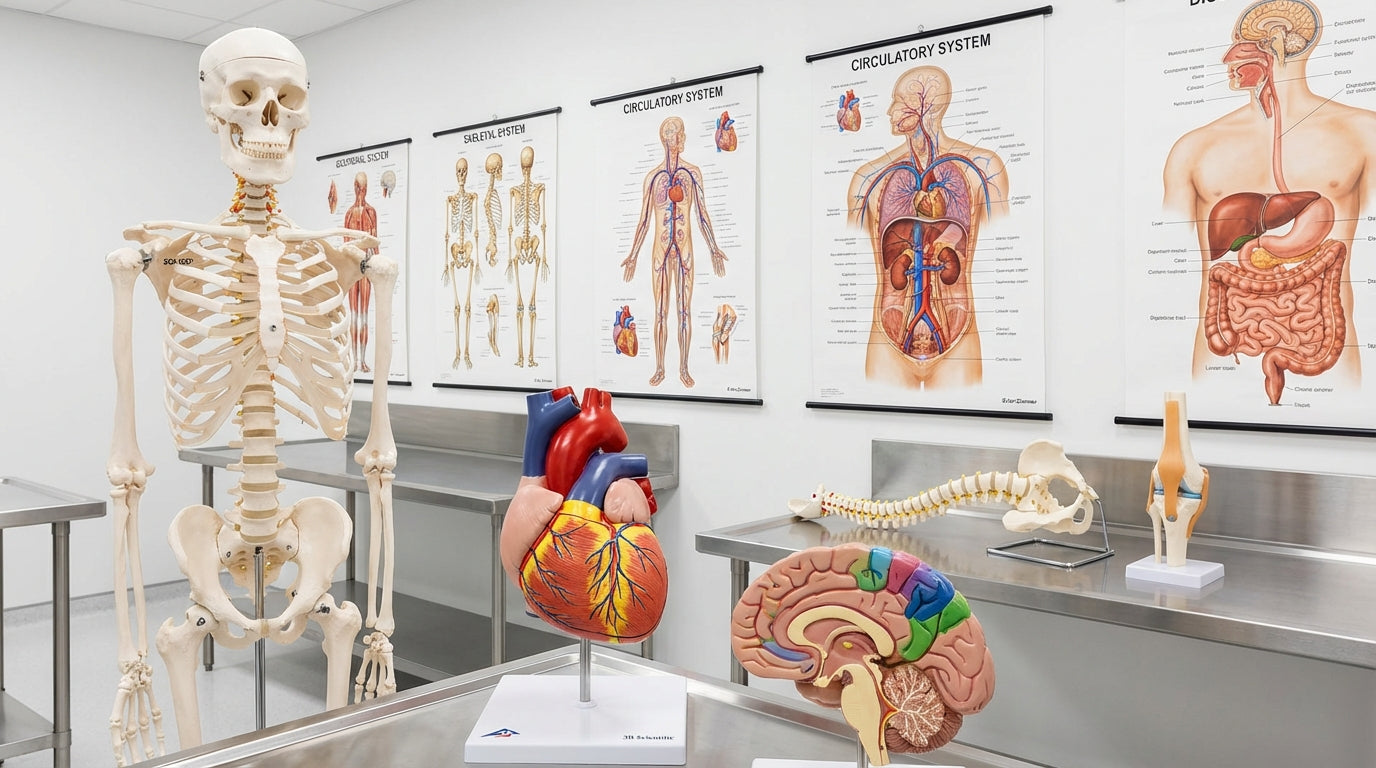
Anatomical models & educational charts
Illustrative anatomical models and teaching boards provide realistic representations of organs, systems and structures to visually explain anatomical relationships. They are used for demonstration and training as well as practical support for diagnostics, treatment planning and to promote hygiene and safety in the workflow.
Anatomical models & teaching charts
Product types and features
The Anatomical Models & Teaching Boards category includes a range of three-dimensional models, sectional models, skeletons, organ replicas, joint and muscle models as well as didactic teaching boards and poster works. In addition to full body and partial skeleton models, the range includes detailed heart, brain, lung and digestive organs, spine and joint models as well as dental and birth representations. Many models are made of robust plastic, some with removable parts, labeled structures or mountable stands for teaching and presentation.
Areas of application and use cases
Anatomical models & teaching boards are used for the visual illustration of anatomical structures, for training in practical processes, for demonstrations in examination and consultation situations and for training in handling and procedures. Educational boards serve to illustrate systems (nervous system, blood circulation, muscular system) and support structured explanations. Removable components and realistic anatomical details make it easier to convey complex connections and promote safe, comprehensible processes.
Functional advantages and quality features
The main advantages are high attention to detail, durable materials and easy cleaning and care properties. Labeled parts, color markings and modular models improve learning effectiveness and quick orientation. Stable standing devices and transportable size classes allow flexible use in training rooms and consulting areas. Hygienic surfaces and removable components make cleaning easier and ensure long-term usability.
Brands and selection criteria
Selection criteria include anatomical precision, material quality, modularity and manufacturer availability. Solutions from manufacturers such as 3B Scientific, Erler-Zimmer and SOMSO often stand for proven quality, detailed labeling and long-lasting workmanship. When purchasing, the scale, scope of assembly (e.g. removable organ parts) and application scenario should be taken into account.
Typical product types (overview)
- Full body and partial skeletons
- Organ models (heart, brain, lungs, kidneys)
- Spine and joint models with ligaments
- Muscle and nervous system representations
- Educational boards and anatomical posters
- Birth and dental models for special demonstrations