
Updated: January 2026 | Reading time: approx. 8 minutes | Category: Emergency Medicine, Guidelines
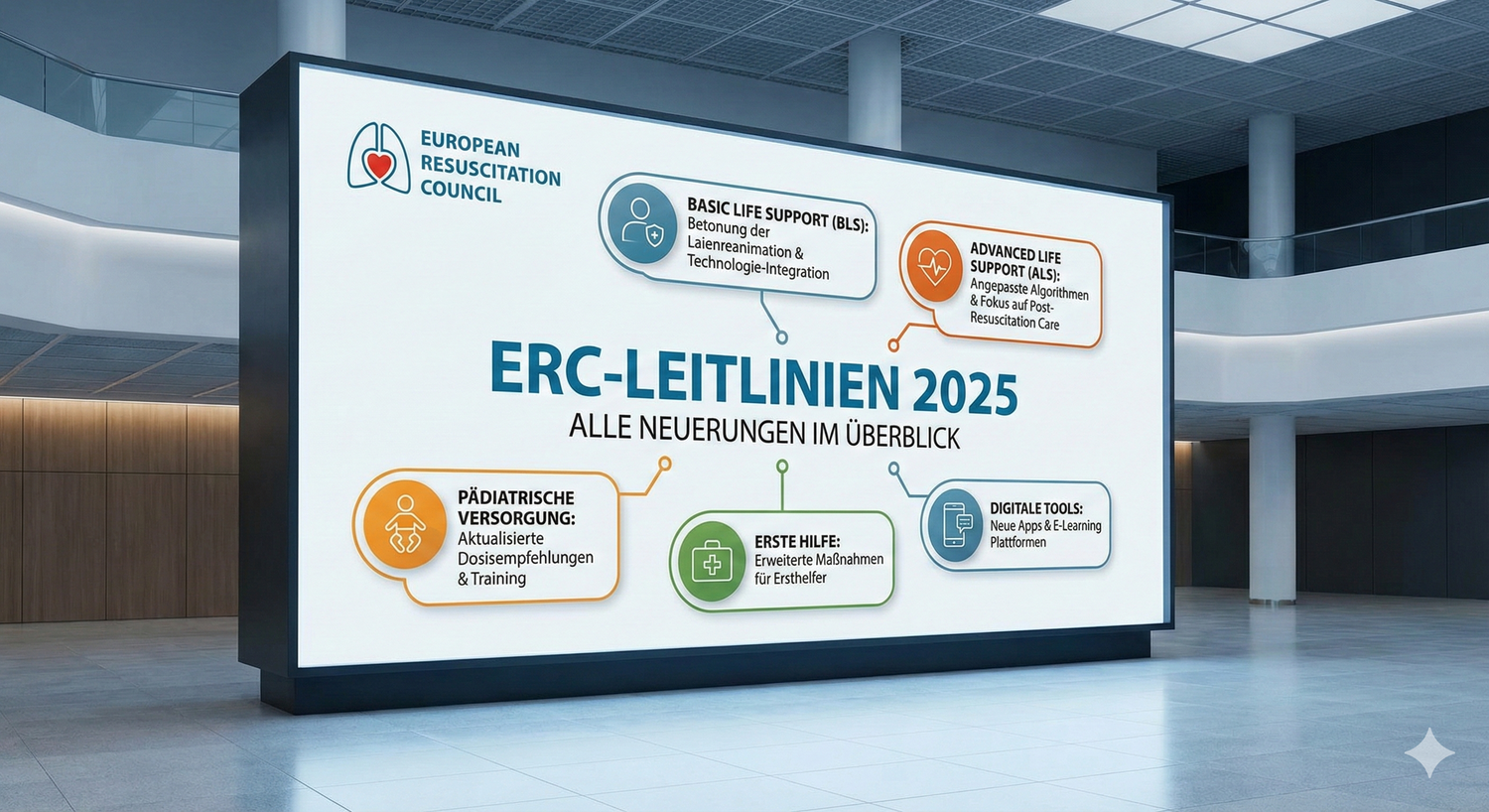
On October 22, 2025, the European Resuscitation Council (ERC) published the new resuscitation guidelines. For medical facilities in Austria, Germany, and Switzerland, this means: time for an update of emergency equipment and training concepts.
The good news: It is an evolution, not a revolution. The core principles remain, but important details have been clarified. In this article, we summarize the essential changes in a practical manner.
📋 The Most Important at a Glance
- Increased focus on the first 3–5 minutes
- Mandatory etCO₂ monitoring (capnography)
- Physiological target parameters: diastolic blood pressure ≥30 mmHg
- Consider Vector Change after 3 unsuccessful shocks
- i-gel before laryngeal tube for supraglottic airways
- Resuscitate children as adults in case of doubt
Why the ERC Guidelines 2025 are Relevant for Your Practice
In Austria, approximately 10,000 people suffer a sudden cardiac arrest outside of a hospital each year. The survival rate in Vienna is about 10–12 percent – significantly below the international top value from Seattle (62%). The crucial factor: the first minutes.
The new ERC guidelines address this directly. They focus even more on the critical time span of the first 3 to 5 minutes after collapse and emphasize the role of early warning systems, telephone resuscitation, and quality-controlled chest compressions.
The 7 Most Important Changes in the ERC Guidelines 2025
1. Chain of Survival Starts Earlier
Resuscitation does not begin only at collapse. The 2025 guidelines emphasize prevention and early detection through early warning systems (Early Warning Scores), telemedicine, and systematic patient monitoring in hospitals and care facilities.
New for laypersons: The breathing check should only be performed after the emergency call – with telephone support from the control center. This allows chest compressions to begin earlier.
💡 For Practices and Clinics: Implementation of early warning systems and regular team training is essential.
2. Mandatory Quality Monitoring with Capnography
End-tidal CO₂ monitoring (etCO₂) becomes the standard in advanced resuscitation. It serves not only for ventilation control but also as an objective quality indicator for thoracic compressions and as an early sign of ROSC.
| Target Parameters | ERC 2025 Recommendation |
|---|---|
| etCO₂ | ≥25 mmHg during CPR |
| Diastolic BP | ≥30 mmHg (with invasive measurement) |
| Compression Depth | 5–6 cm in adults |
| Compression Rate | 100–120/min |
💡 Practice Tip: Modern defibrillators with integrated capnography provide real-time feedback on resuscitation quality. Check if your devices offer this feature.
3. Defibrillation: Vector Change after 3 Shocks
Defibrillation remains central for ventricular fibrillation and pulseless ventricular tachycardia. New is the explicit recommendation to consider a “Vector Change” after three unsuccessful shocks – that is, to switch the electrodes from the anterolateral to the anteroposterior position.
- First Shock: 150–200 Joules (biphasic)
- Subsequent Shocks: same or higher energy (up to 360 J)
- After 3rd Shock: Consider Vector Change
- Double Sequence Defibrillation is not routinely recommended
Important: In trained teams, “Precharging” can be used – charging the defibrillator during ongoing thoracic compressions to minimize hands-off time.
4. Ventilation and Airway Management
The ventilation parameters have been standardized. For supraglottic airway devices, i-gel is preferred over laryngeal tube – due to easier handling and better sealing.
| Parameter | Recommendation |
|---|---|
| Tidal Volume | 6–8 ml/kg BW |
| Respiratory Rate | 10/min |
| PEEP | 0–5 cmH₂O |
| Supraglottic Airway Device | i-gel preferred |
5. Medication Therapy: Adrenaline and Amiodarone
The administration of medications remains essentially unchanged:
- Adrenaline (1 mg i.v.): as early as possible for non-shockable rhythm, after the 3rd shock for shockable rhythm
- Amiodarone (300 mg): after the 3rd shock, repeat with 150 mg after the 5th shock
Special Note for Hypothermia (<30°C): A single dose of 1 mg adrenaline, further doses only above >30°C in extended intervals (6–10 minutes instead of 3–5 minutes).
6. Pediatric Resuscitation: Simplification in Emergencies
An important clarification: In case of doubt, children should be resuscitated like adults. This recommendation aims to lower the threshold for lay rescuers.
- Defi Pads: Anteroposterior position recommended for children <25 kg
- Infants: Thoracic compression with 2-finger “grasp” technique
- Defibrillation Energy: 4 J/kg body weight
7. Post-Resuscitation Treatment: Update on Temperature Management
Based on the TTM2 study, the recommendation for temperature management has been adjusted. The focus is now on consistent fever prevention (<37.7°C) for at least 72 hours. Active hypothermia (32–36°C) is still possible but is no longer generally recommended.
⚠️ Important: Prehospital cooling with cold infusions is not recommended. Temperature management begins in the intensive care unit.
What Remains the Same?
The core principles of resuscitation remain unchanged. This continuity is important, as frequent changes could lead to confusion:
- Compression-Ventilation Ratio: 30:2
- Compression Depth: 5–6 cm in adults
- Compression Rate: 100–120/min
- Earliest possible defibrillation for ventricular fibrillation/VT
- Minimal interruptions of chest compressions
✅ Checklist: Is Your Practice Ready for 2025?
- ☐ Defibrillator with capnography function available?
- ☐ Defi pads for anteroposterior placement available?
- ☐ i-gel as supraglottic airway device available?
- ☐ Emergency medications (Adrenaline, Amiodarone) readily available?
- ☐ Team training according to ERC 2025 planned or conducted?
- ☐ Algorithms (BLS/ALS) updated and posted?
- ☐ Early warning system for high-risk patients implemented?
Conclusion: Fine-Tuning Instead of Revolution
The ERC Guidelines 2025 do not bring dramatic changes but important clarifications. The focus on measurable quality parameters (etCO₂, diastolic blood pressure) and the emphasis on the critical first minutes underline: Good resuscitation is not a coincidence, but the result of preparation, training, and the right equipment.
As a medically-led specialist retailer, we are happy to assist you in selecting the appropriate emergency equipment – from defibrillators with capnography to airway devices and emergency kits according to current guidelines.
Emergency Equipment According to ERC 2025?
We are happy to advise you on defibrillators, i-gel airway devices, and emergency kits.
To Emergency Equipment →Sources and Further Links
- European Resuscitation Council: Guidelines 2025
- German Resuscitation Council: Compact Guidelines 2025
- Emergency + Rescue Medicine: Summary of the ERC Guidelines 2025 (Springer)
- ILCOR: Consensus on Science
About the Author
This article was created by the editorial team of MeinArztbedarf GmbH. Our team is led by Dr. Daniel Pehböck, a physician with clinical experience in emergency and intensive care medicine. If you have questions about emergency equipment, we are happy to advise you personally.
0 Comments