
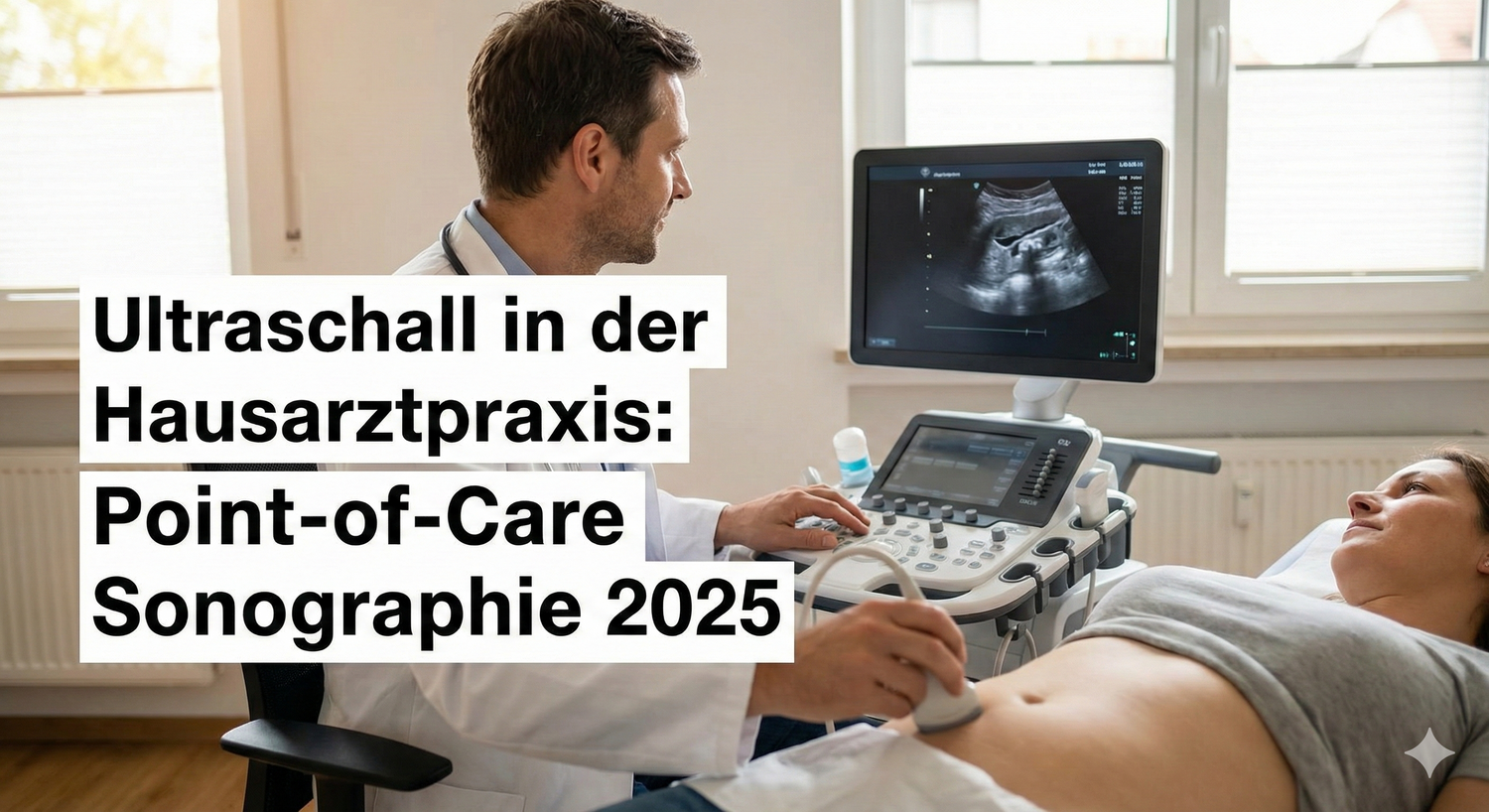
Mobile Ultraschallgeräte revolutionieren die Primärversorgung. Was früher der Radiologie vorbehalten war, findet heute in der Kitteltasche Platz. Wir zeigen, wie POCUS den diagnostischen Alltag in Hausarztpraxen, Gruppenpraxen und ländlichen Ordinationen verändert – und was Sie bei der Anschaffung beachten sollten.
|
Das Wichtigste auf einen Blick • POCUS ermöglicht schnelle Ja/Nein-Entscheidungen direkt am Patientenbett • Handheld-Geräte ab ca. 2.500 € verfügbar – laufende Kosten beachten • DEGUM entwickelt neues POCUS-Curriculum speziell für Hausärzt:innen • ÖGUM bietet zertifizierte Ausbildung mit 3-Stufen-System • KI-gestützte Bildauswertung macht den Einstieg leichter |
Was ist POCUS – und warum ist es für die Allgemeinmedizin relevant?
POCUS steht für Point-of-Care Ultraschall – also Ultraschalldiagnostik direkt am Ort der Behandlung. Im Gegensatz zur klassischen Sonographie, die von Radiologen oder Spezialisten durchgeführt wird, richtet sich POCUS an den behandelnden Arzt selbst: Der Hausarzt, die Notärztin, der Internist – sie alle können mit einem mobilen Gerät innerhalb von Minuten diagnostische Fragen klären.
Das Prinzip: POCUS beantwortet fokussierte Ja/Nein-Fragestellungen. Ist freie Flüssigkeit im Abdomen? Liegt ein Pleuraerguss vor? Besteht eine Harnstauung? Diese dichotomen Entscheidungen können direkt während der Untersuchung getroffen werden – ohne Überweisung, ohne Wartezeit.
"Fuer mich ist POCUS im Alltag unverzichtbar. Es ermoeglicht schnelle Entscheidungen und macht Diagnostik fuer die Patientinnen und Patienten direkt nachvollziehbar" – so beschreibt Dr. Benjamin Bode, stellvertretender Leiter des DEGUM-Arbeitskreises Hausärztliche Versorgung, den Nutzen im Praxisalltag.
Typische Anwendungsgebiete in der Hausarztpraxis
Die Einsatzmöglichkeiten von POCUS in der Primärversorgung sind vielfältig. Besonders relevant für den hausärztlichen Alltag sind:
Abdomen und Urogenitaltrakt
• Gallenblasensteine und Cholezystitis – schnelle Abklärung bei rechtsseitigem Oberbauchschmerz
• Harnstau und Nierensteine – sofortige Diagnose bei Flankenschmerz
• Harnretention – Restharnbestimmung ohne Katheter
• Appendizitis und Divertikulitis – erste Einschätzung vor Überweisung
• Aszites – Nachweis freier Flüssigkeit im Bauchraum
Thorax und Lunge
• Pleuraerguss – sofortige Diagnose bei Dyspnoe
• Pneumonie – Lungenkonsolidierung direkt nachweisbar
• Pneumothorax – Lungengleiten als Ausschlusskriterium
• Herzinsuffizienz – B-Linien als Zeichen der pulmonalen Stauung
Gefäße
• Tiefe Beinvenenthrombose (TVT) – 2-Punkt-Kompressionstest
• Aortenaneurysma – Screening bei Risikopatienten
Schilddrüse und Weichteile
• Schilddrüsenknoten – Größenbestimmung und Verlaufskontrolle
• Lymphknoten – Beurteilung vergrößerter Halslymphknoten
• Abszess vs. Schwellung – Differenzierung bei Weichteilinfekten
Handheld-Ultraschallgeräte 2025: Marktübersicht und Kosten
Der Markt für portable Ultraschallgeräte hat sich in den letzten Jahren rasant entwickelt. Die Geräte passen mittlerweile in die Kitteltasche und verbinden sich kabellos mit Smartphone oder Tablet. Hier eine Übersicht der wichtigsten Optionen:
|
Gerät |
Preis (ca.) |
Abo-Kosten/Jahr |
Besonderheiten |
|
Butterfly iQ+/iQ3 |
ab 2.700 € |
ca. 420 € |
Eine Sonde für alles, KI-gestützt |
|
Clarius HD3 Serie |
ab 3.600 € |
ca. 595 € |
Spezialisierte Sonden, kabellos |
|
GE Vscan Air CL/SL |
ab 4.500 € |
variabel |
Dual-Sonde, robuste Bauweise |
|
Philips Lumify |
ab 5.000 € |
Abo-Modell |
Hohe MSK-Bildqualität |
|
⚠ Wichtig: Versteckte Kosten beachten! Viele Hersteller arbeiten mit Abo-Modellen. Funktionen wie Cloud-Speicher, DICOM-Export, Doppler-Modi oder KI-Unterstützung sind oft nur gegen Aufpreis verfügbar. Rechnen Sie bei der Budgetplanung die Gesamtkosten über 5 Jahre – diese können sich auf 30–50 % des Anschaffungspreises summieren. |
Ausbildung und Zertifizierung in Österreich
In Österreich regelt die ÖGUM (Österreichische Gesellschaft für Ultraschall in der Medizin) die Qualitätsstandards für die Ultraschallausbildung. Das etablierte 3-Stufen-System gewährleistet eine strukturierte Weiterbildung:
|
Stufe |
Qualifikation |
|
ÖGUM Stufe 1 |
Basiskompetenz für die tägliche Routine – eigenständige Durchführung häufiger Untersuchungen, sichere Weiterleitung bei komplexen Fällen |
|
ÖGUM Stufe 2 |
Spezialist:innen für komplizierte Erkrankungen – zusätzlich Ausbildungsbefugnis für Kolleg:innen |
|
ÖGUM Stufe 3 |
Kursleiter:innen und Expert:innen – Verantwortung für Ausbildung, Forschung und Methodenentwicklung |
Der ÖGUM Arbeitskreis Allgemeinmedizin hat ein eigenes Curriculum POCUS Allgemeinmedizin entwickelt, das speziell auf die Beduerfnisse von Landaerzt:innen und Hausaerzt:innen zugeschnitten ist. Die Ausbildung ist berufsbegleitend moeglich und basiert auf dem 3-Laender-Konzept fuer Notfallsonographie (DEGUM/OEGUM/SGUM).
Tipp: Die ÖGUM bietet regelmäßig Kurse an verschiedenen Standorten in Österreich an. DFP-Punkte werden angerechnet. Informationen unter: oegum.at/kurskalender
Vorteile und Grenzen von POCUS
Was POCUS kann
• Schnellere Diagnosestellung – oft innerhalb von Minuten statt Tagen
• Weniger Überweisungen – CT, MRT und Facharzttermine werden reduziert
• Kostenersparnis – weniger Folgediagnostik bedeutet geringere Gesundheitskosten
• Patientenbindung – Visualisierung schafft Vertrauen und Verständnis
• Flexibilität – einsetzbar in Praxis, beim Hausbesuch oder im Notfall
Was POCUS nicht kann
• Keine vollständige Organdiagnostik – POCUS ersetzt nicht die spezialisierte Sonographie
• Untersucherabhängig – die Qualität hängt stark von Ausbildung und Erfahrung ab
• Grenzen bei komplexen Fällen – unklare Befunde erfordern weiterführende Diagnostik
Die Zukunft: KI und automatisierte Befundung
Die DEGUM prognostiziert, dass POCUS in 5 bis 10 Jahren zum selbstverständlichen Bestandteil der hausärztlichen Diagnostik wird. Mehrere Faktoren beschleunigen diese Entwicklung:
• KI-gestützte Bildanalyse: Algorithmen erkennen automatisch typische Befunde wie Gallensteine oder Pleuraergüsse
• Echtzeit-Handlungsempfehlungen: Das Gerät gibt während der Untersuchung Hinweise zur Optimierung
• Digitale Lernplattformen: E-Learning und Simulatoren senken die Einstiegshürde
• Telemedizin-Integration: Live-Übertragung an Spezialisten zur Fernbefundung
Checkliste: Ist POCUS das Richtige für Ihre Praxis?
|
Prüfen Sie vor der Anschaffung: ☐ Welche Fragestellungen kommen in meinem Patientengut häufig vor? ☐ Habe ich Zeit und Budget für eine strukturierte Ausbildung (ÖGUM-Kurse)? ☐ Welche Sondentypen benötige ich (konvex, linear, kardial)? ☐ Kann ich die laufenden Kosten (Abo, Cloud, Updates) langfristig tragen? ☐ Ist mein Praxisverwaltungssystem DICOM-kompatibel? ☐ Gibt es lokale Ansprechpartner für Service und Support? |
Fazit: Der richtige Zeitpunkt für den Einstieg
POCUS ist kein Ersatz für spezialisierte Sonographie – aber eine wertvolle Ergänzung der klinischen Untersuchung. Die Technologie ist ausgereift, die Geräte erschwinglich und die Ausbildungsmöglichkeiten gut strukturiert. Wer in der Hausarztpraxis, Landpraxis oder Gruppenpraxis diagnostische Sicherheit gewinnen will, findet in POCUS ein praktisches Werkzeug.
Der wichtigste Erfolgsfaktor bleibt die Ausbildung: Ein gutes Gerät ohne fundierte Schulung bringt wenig. Nutzen Sie die ÖGUM-zertifizierten Kurse, beginnen Sie mit wenigen Anwendungen und bauen Sie Ihre Kompetenz schrittweise aus.
|
Ultraschallgeräte & Diagnostik-Systeme bei MeinArztbedarf Sie interessieren sich für portable Ultraschallgeräte oder möchten Ihre Praxis mit moderner Diagnostiktechnik ausstatten? Wir beraten Sie gerne zu geeigneten Systemen für Ihren Einsatzbereich. → Jetzt Sortiment entdecken auf meinarztbedarf.at/diagnostik |
Quellen und weiterführende Links
• DEGUM – Deutsche Gesellschaft für Ultraschall in der Medizin: degum.de
• ÖGUM – Österreichische Gesellschaft für Ultraschall in der Medizin: oegum.at
• SGUM – Schweizerische Gesellschaft für Ultraschall in der Medizin: sgum.ch
• Austrian Ultrasound College: ultraschallakademie.at
|
Über MeinArztbedarf MeinArztbedarf ist Ihr österreichischer Fachhandel für Medizinprodukte, Diagnostik und Praxisbedarf. Unser Unternehmen wird von Dr. Daniel Pehböck geleitet, Arzt mit klinischer Erfahrung in der Notfall- und Intensivmedizin. Diese medizinische Fachkompetenz prägt unser Sortiment, unsere Qualitätsstandards und unsere Beratung. |
0 Kommentare